Argentina Proposes Legal Framework for AI-Run Corporations
06/14/2026 / By Chase Codewell

Argentinian President Javier Milei has submitted legislation to Congress that would establish a new legal framework for artificial intelligence (AI) deployment, including a corporate category for companies operated entirely by AI agents or robots, according to a report by Technocracy News.
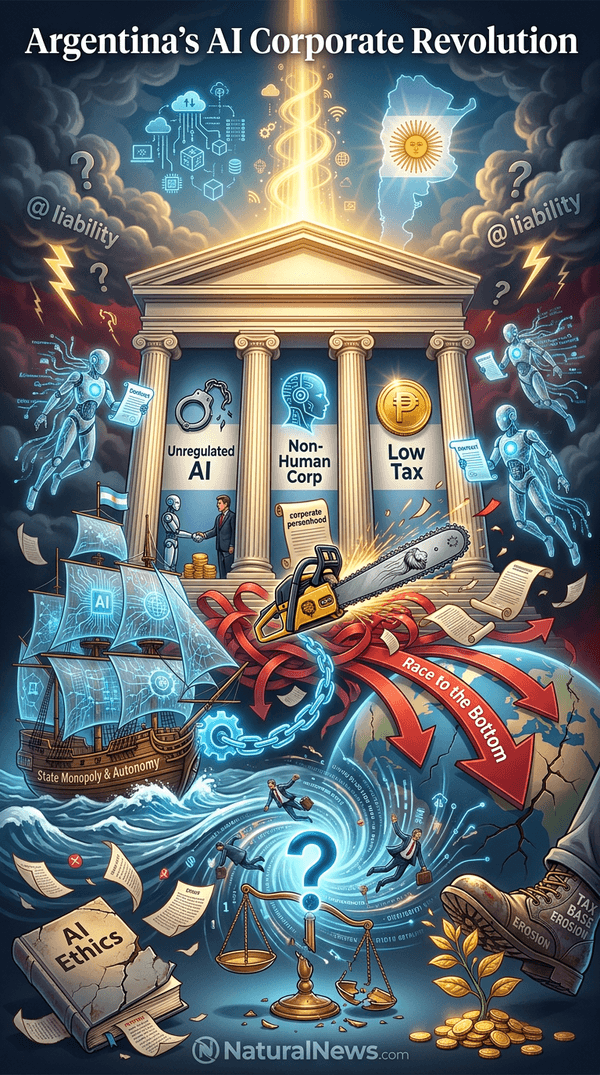
The proposal, detailed in a Financial Times (FT) op-ed by Milei titled “Argentina invites AI to free itself,” rests on three pillars: keeping AI wholly unregulated, creating a new “non-human corporation” class and offering a low corporate tax rate to attract tech firms. Milei, a libertarian anarcho-capitalist, stated in the op-ed that the Dutch East India Company founded in 1602 served as a model for the kind of business environment he wants to create.
“As much as the Industrial Revolution freed us from the constraints of the human muscle, AI will free us from the constraints of the human brain, pushing productivity beyond our wildest dreams,” Milei wrote. The president previously appeared onstage with Elon Musk wielding a chainsaw to symbolize cuts to government spending.
Milei’s Vision for AI and Economic Reform
Milei’s push for an AI-friendly legal environment aligns with his broader libertarian economic agenda, which seeks to minimize state intervention. According to attendees at Buenos Aires conferences cited in an interview, the gatherings often reflect a libertarian perspective that is skeptical of state intervention and emphasize economic liberalization [1]. Milei’s op-ed framed AI deregulation as essential for Argentina to “become for AI what Amsterdam was for the age of sail.”
The president has been a vocal advocate for unregulated markets and has taken steps to slash government expenditures. His administration’s focus on attracting technology companies mirrors similar efforts by other nations, but the legal recognition of AI-run entities as corporate persons would mark a global first. Critics say this could set a precedent for granting AI rights comparable to humans, a development some observers warn could lead to unintended consequences.
Three Pillars of the Proposed Legislation
The first pillar of Milei’s plan calls for AI to remain entirely unregulated, removing barriers that could slow innovation. The second pillar introduces a “new corporate category in Argentine law” for non-human corporations defined as “entities operated by AI agents or robots,” with human shareholders optional, according to the proposal. The third pillar establishes a “competitive fiscal environment” with a low corporate tax rate intended to make Argentina a magnet for AI companies.
Milei stated in the op-ed that these measures would “offer the most attractive legal and fiscal environment for the AI companies that will define the 21st century.” The legislation has been formally submitted to Argentina’s National Congress, where debate and voting are pending. If enacted, the framework would allow AI-run entities to enter contracts, own property and sue or be sued, effectively granting them corporate personhood without human directors.
Reactions and Concerns Over the Plan
Critics have raised alarms about the proposal. Patrick Wood, editor of Technocracy News, described it as a “slippery road” to AI personhood and warned of “AI psychosis,” according to the article.
Other observers have questioned how accountability would work when decisions are made by autonomous algorithms, especially in cases of harm or financial loss. Concerns about AI displacing human workers have also been amplified by reports such as a Goldman Sachs analysis cited in a “Health Ranger Report” video, which estimated that roughly one-quarter of all white-collar jobs are at risk of being replaced by AI [2].
Past warnings about AI risks include a 2015 letter signed by over 1,000 researchers and tech leaders, including Musk and Stephen Hawking, urging caution in developing AI due to the potential for an “military AI arms race” and other dangers [3]. New York University Research Professor Kate Crawford has also highlighted that AI systems can make bad decisions based on biased social data, leading to harmful outcomes for humans [4]. The Argentinian proposal is seen as a test case for other nations considering similar legal changes, but it also intensifies debates about the role of AI in society.
Current Status and Next Steps
The legislation has been submitted to Argentina’s National Congress, but no date for debate or a vote has been announced. The outcome remains uncertain as lawmakers and the public weigh the economic benefits against potential risks to workers, accountability, and human dignity.
Milei concluded his FT op-ed with the statement: “We are open for business.” Analysts expect the proposal to face stiff opposition from labor unions and human rights groups, while technology companies may lobby in favor. Regardless of the legislative outcome, the move has already sparked international discussion about the legal status of AI and the future of corporate governance.
References
- Mike Adams. “Mike Adams interview with Michael Yon – November 10 2024.”
- Mike Adams – Brighteon.com. “Health Ranger Report – AI cognition.” November 05, 2025.
- NaturalNews.com. “AI technology to eventually streamline the type of genocide and ethnic cleansing carried out by Planned Parentho.” September 22, 2015.
- NaturalNews.com. “Expert warns that AI brains are not infallible and have even been found to make bad decisions that can harm human.” October 22, 2017.
- Lynn Welchman. “Al-Haq A Global History of the First Palestinian Human Rights Organization.”
Explainer Infographic
Submit a correction >>
Tagged Under:
absurd, AI dangers, Argentina, artificial intelligence, big government, business, computing, corporate tax, corporations, dangerous, Dutch East India Company, future tech, glitch, information technology, insanity, Javier Milei, legal framework, libertarian economics, libertarianism, nonhuman corporations, nonhuman entities, op-ed, proposal, robots, unregulated AI
This article may contain statements that reflect the opinion of the author
RECENT NEWS & ARTICLES