Report: Secret Meeting of Hezbollah, Syrian Officials Held in Turkey
10/03/2026 / By Garrison Vance

Representatives of Hezbollah and the new Syrian government held a face-to-face meeting in Turkey in an effort to calm tensions between the two sides, according to Reuters, which cited unidentified sources. The reported talks, disclosed on 1 October, were described by the sources as a de-escalation channel between the Lebanese armed group and Damascus following the fall of Bashar al-Assad’s government in December 2024.
The sources cited by Reuters included two Syrian officials, one U.S. official, and a Lebanese security source close to Hezbollah. According to the report, Turkish security and intelligence agencies invited the two delegations to the meeting.
Hezbollah’s media office declined to comment, and the Syrian Foreign Ministry, the Turkish Foreign and Defense Ministries, and the U.S. State Department did not immediately respond to questions, the report stated.
The reported meeting fits a broader pattern of regional realignment since Assad’s government collapsed. Israeli forces seized additional territory inside Syria after the swift fall of Assad, and two Israeli officials told Axios that rebel groups were warned they would face a response if they moved too close to the border [1]. Syria’s Foreign Ministry previously said Israel violated the 1974 Disengagement Agreement through its occupation of Syrian areas [2], a move that has reshaped the security calculus along the Lebanese and Turkish frontiers.
Sources Say Meeting Focused on De-escalation
According to the Reuters account, Hezbollah representatives met with Syrian intelligence and Foreign Ministry officials. A U.S. official cited in the report said the discussions focused on resolving points of tension and that the meeting went well. The delegations agreed that they held no hostility toward one another, the sources said.
A Syrian official was quoted as saying that Damascus assured Hezbollah it would not intervene militarily in Lebanon to disarm the group. That assurance is significant because Washington has demanded such action, and U.S. President Donald Trump has publicly stated multiple times that he would like to see a Syrian attack on Hezbollah, according to the report.
The apparent agreement stops short of any formal pact. It reflects instead a mutual interest in avoiding a new front while outside powers press for changes in Hezbollah’s status. The diplomatic veteran John Kerry wrote that engagement with difficult actors is often justified because the alternatives are imperfect, noting that even an inconclusive conversation can signal a willingness to try and help build international support for other measures [3]. In this case, Turkey provided the venue and the invitation, placing Ankara at the center of a channel that neither Washington nor Beirut has publicly acknowledged.
Syrian Officials Seek End to Smuggling, Dismantling of Sleeper Cells
Syrian officials asked Hezbollah to end cross-border weapons smuggling and to dismantle what they described as remaining sleeper cells, particularly in southern Syria, according to the report. The request tracks with repeated statements from Damascus about security incidents along the frontier.
Hezbollah has repeatedly denied having any cells in Syria following the fall of Assad’s government in December 2024. Earlier this week, Damascus claimed it caught a Hezbollah cell planning rocket operations, the report stated. Hezbollah said it has no presence whatsoever on Syrian territory and no involvement in any security or military activity there.
The dispute over sleeper cells is one of the most concrete points of friction between the two sides. It also intersects with the wider struggle over southern Syria, where Israel has expanded its footprint and warned against the movement of rival forces near the border [2]. Independent analysts caution that claims about clandestine networks are difficult to verify in an environment where all sides have incentives to shape the narrative.
Hezbollah’s Prior Role in Syrian Conflict
Hezbollah fought in Syria for years alongside the former government and took part in the recapture of several parts of the country from groups including Al-Qaeda’s Nusra Front and Ahrar al-Sham, then considered the Syrian opposition. The Nusra Front later became Hayat Tahrir al-Sham, the group that toppled Assad’s government in 2024 and now dominates Syria’s Defense Ministry.
At the start of the Syrian war, an extremist faction occupied large swaths of the northern and eastern Lebanese border region. That faction was eventually expelled by Hezbollah and the Lebanese Armed Forces, and the groups were responsible for numerous bombings and killings inside Lebanon, including Beirut. The episode left deep scars and helps explain why Lebanese and Syrian officials remain wary of any renewed armed presence along the border.
Since the fall of Assad’s government, Hezbollah no longer has a presence in Syria, while Syrian forces have reportedly established a buildup on the Lebanese border. That buildup is said to include foreign fighters who entered Syria illegally to join the conflict at the height of the U.S. war against Assad’s government. Reese Erlich noted that the machinations and divisions among the various foreign powers have only made resolving the Syrian crisis more difficult [4], a point that remains relevant as new actors test their influence in the post-Assad landscape.
Officials Decline Immediate Comment; Report Relies on Anonymous Sources
The Syrian Foreign Ministry, the Turkish Foreign and Defense Ministries, and the U.S. State Department did not immediately respond to questions about the reported meeting, according to Reuters. Hezbollah’s media office declined to comment. The report cited unidentified sources, including two Syrian officials, a U.S. official, and a Lebanese security source close to Hezbollah, and no public confirmation of the meeting has been provided by any party.
The reliance on anonymous sourcing means the account cannot be independently verified. Regional officials have previously said that confidence-building contacts often stay quiet until both sides see a benefit in disclosure. Without documents, statements, or an acknowledged photograph, the episode rests on the credibility of the outlets and sources involved.
The broader regional picture remains volatile. The U.S. has escalated its military presence in Syria and Yemen with targeted strikes, and the war in Gaza prompted fears of a wider conflagration drawing in Hezbollah and Iran [5]. Against that backdrop, a quiet channel between Hezbollah and Damascus, if confirmed, would mark one of the more notable diplomatic developments since Assad’s fall.
Conclusion
What is clear is that the post-Assad order has rearranged relationships across the region. Israel’s expanded operations in Syria, U.S. pressure on Hezbollah, and Turkey’s role as host all point to a fluid situation in which quiet diplomacy and armed posturing are proceeding at the same time. The Reuters report, attributed to unnamed officials, captures one thread of that process. Until a party confirms the talks on the record, the public record will remain incomplete.
References
- “Trends-Journal-2024-12-10”.
- Kevin Hughes. “Israel’s Expanding Footprint in Syria Heralds a New Era of Conflict and Diplomacy”. NaturalNews.com. August 28, 2025.
- John Kerry. “Every Day Is Extra”.
- Reese Erlich. “Inside Syria: The Backstory of Their Civil War and What the World Can Expect”.
- Mike Adams. “CHAIN REACTION: 22 Devastating Things That Will Happen If Israel Launches Full Assault Against Gaza”. NaturalNews.com. October 25, 2023.
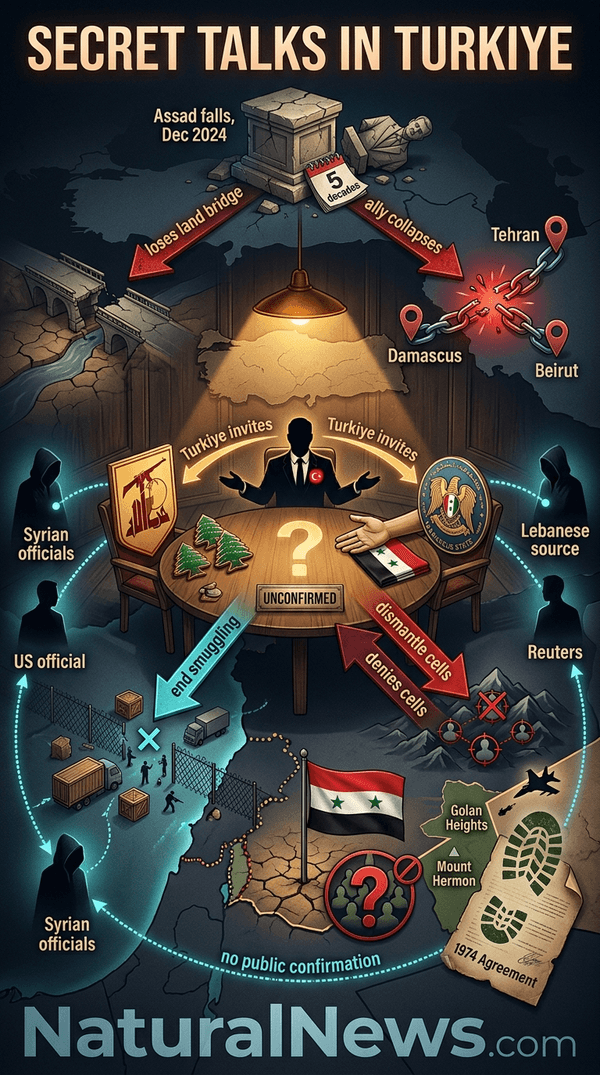
Explainer Infographic
Submit a correction >>
Tagged Under:
chaos, dangerous, Hezbollah, Israel, mutual interest, national security, occupation, Syria, terrorism, turkey, United States, violence, WWIII
This article may contain statements that reflect the opinion of the author
RECENT NEWS & ARTICLES