Pentagon Awards Boeing Over $20B to Build Sixth-Generation Navy Fighter
10/04/2026 / By Garrison Vance
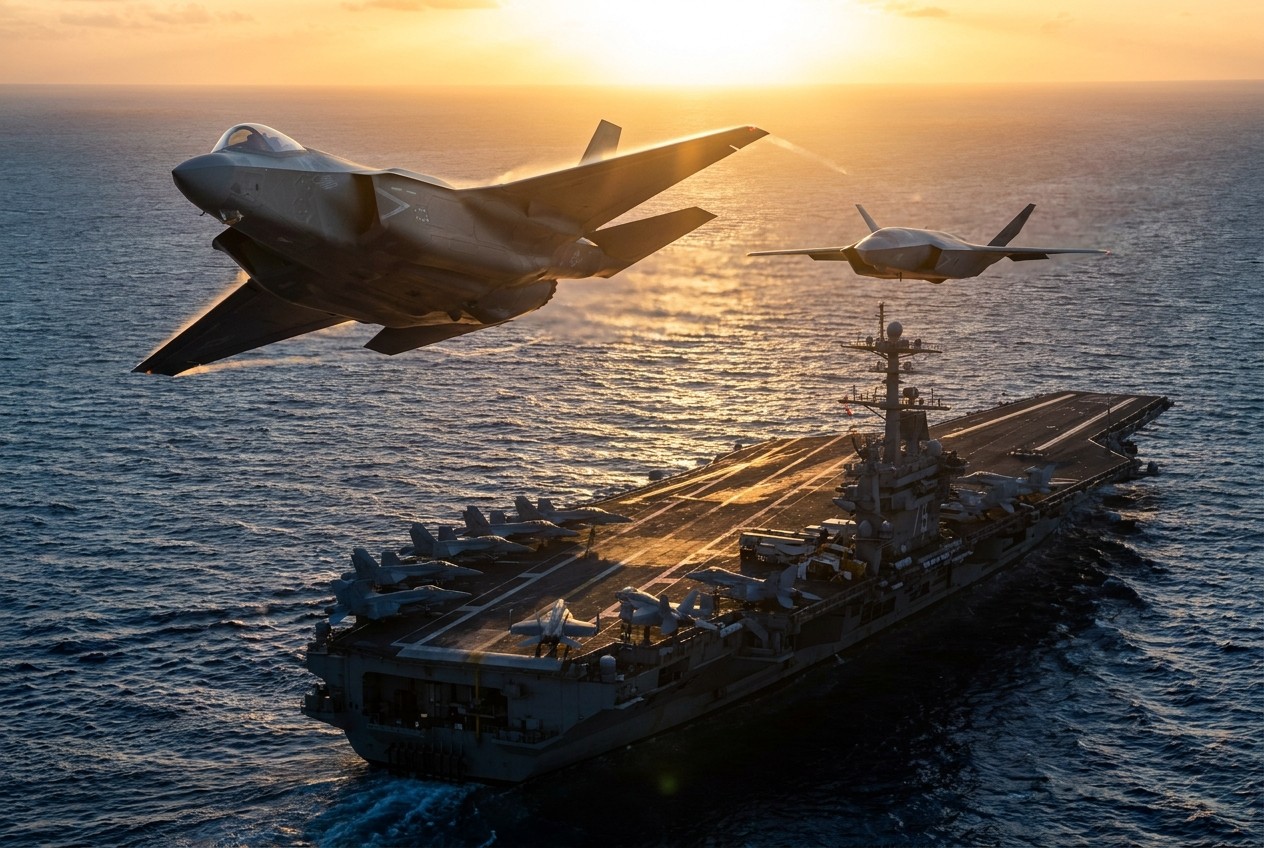
The U.S. Navy has selected Boeing as the winner of its F/A-XX next-generation carrier-based fighter competition, ending a procurement process that had been delayed after the Department of War attempted to shelve the program, according to The War Zone (TWZ) [1].
The contract carries a reported value exceeding $20 billion and names Boeing as prime contractor for the Navy’s sixth-generation air dominance platform. The F/A-XX program faced an extended limbo period after the Pentagon moved to effectively pause it.
Congress intervened through a defense spending bill that allocated nearly $900 million to the effort and pushed for a final selection, according to TWZ [2]. The Navy’s top admiral had set an August target for entering the next contracting phase, a deadline the service ultimately passed before making the announcement [3].
Boeing competed against Northrop Grumman for the award. An earlier down-select reportedly eliminated Lockheed Martin in March, according to TWZ [1]. Northrop Grumman CEO Kathy Warden had previously stated she was confident in her company’s ability to deliver next-generation carrier-based fighters if selected [4].
Contract Details and Program Scope
The award covers engineering, manufacturing and development work on a carrier-capable stealth fighter intended to replace the Navy’s current fleet of F/A-18E/F Super Hornets. The Navy’s top officer said the global proliferation of increasingly capable air defense systems underscores the need for the F/A-XX, warning that the service’s ability to fly with impunity using non-stealthy platforms is eroding even against smaller nation-state adversaries like Iran [5].
The aircraft is expected to incorporate advanced stealth, sensor fusion, and manned-unmanned teaming capabilities. Boeing has separately been conducting test flights of its MQ-28 Ghost Bat drone from the Navy’s base at Point Mugu, California, as part of broader efforts to demonstrate drone maturity for potential integration with crewed platforms [6]. The Air Force’s top officer in the Pacific has said the service is threaded in tight with Australian MQ-28 work, with lessons feeding into collaborative combat aircraft plans [7].
Design and development of sixth-generation fighters has featured discussion of directed-energy weapons since at least 2015, when Northrop Grumman’s vice president for research, technology, and advanced design described laser-armed fighter concepts that remained largely on the drawing board, according to NaturalNews.com [8]. More recently, discussion has emerged about whether China’s J-36 next-generation tailless heavy tactical jet might receive a laser directed-energy weapon, [9].
Strategic and Budgetary Context
The contract is part of broader U.S. military efforts to modernize air superiority assets amid competition with China and Russia. A Pentagon report previously concluded that China is working to build a military capable of rivaling, if not surpassing, that of the U.S., identifying the People’s Republic of China as the only competitor with the intent and increasingly the capacity to reshape the international order, according to NaturalNews.com [10].
Industrial base concerns have shadowed both the Navy’s F/A-XX and the Air Force’s F-47 sixth-generation programs. A top Pentagon procurement officer attributed the Navy program’s earlier pause in part to concern that the U.S. industrial base could not handle simultaneous final development and production of two extremely complex new fighter aircraft, a justification many observers found difficult to accept [11]. Boeing is in the midst of a nearly $2 billion expansion of its St. Louis, Missouri facilities tied to F-47 work, according to TWZ [12].
Conclusion
The Pentagon has not announced a first flight date for the Navy’s sixth-generation fighter, according to officials. Boeing and the Navy said additional program details would be released as the contract moves into execution.
The award remains subject to congressional oversight and future budget approvals, the Pentagon stated. Congress has repeatedly intervened in the program’s trajectory, restoring funding when the Pentagon sought to pause it and setting deadlines for a down-select decision, according to TWZ [2].
Broader questions about the affordability of large-scale military modernization persist. According to the Stockholm International Peace Research Institute, the U.S. spent $21 trillion on its military between 2001 and 2024 in constant 2024 dollars, equal to the combined military spending of the next eighteen countries, as reported by Medea Benjamin and Nicolas J. S. Davies [17].
As with all major defense acquisition programs, the F/A-XX will undergo continued scrutiny as design, testing and production proceed.
References
- Tyler Rogoway. “Boeing Wins F/A-XX Next Generation Navy Stealth Fighter Contract”. The War Zone. September 29, 2026.
- Joseph Trevithick. “F/A-XX Naval Fighter Rescued From Purgatory In New Defense Spending Bill”. The War Zone. January 20, 2026.
- Joseph Trevithick. “F/A-XX Stealth Fighter Selection To Finally Come By August: Navy’s Top Admiral”. The War Zone. April 20, 2026.
- Joseph Trevithick. “Northrop Defends Ability To Build F/A-XX 6th Gen Naval Fighters If Selected”. The War Zone. April 21, 2026.
- Joseph Trevithick. “F/A-XX Naval Fighter Needed For Adversaries Like Iran, Not Just China and Russia: Navy Boss”. The War Zone. January 28, 2026.
- Joseph Trevithick. “MQ-28 Ghost Bat Now Flying Over The Pacific From U.S. Navy Base”. The War Zone. May 28, 2026.
- Joseph Trevithick. “Australian MQ-28 Ghost Bat Fighter Drones Could Be Commanded By U.S. Pilots”. The War Zone. July 27, 2026.
- NaturalNews.com. “Air Force’s Sixth Generation fighter to be equipped with lasers”. NaturalNews.com. December 17, 2015.
- Joseph Trevithick. “China’s Recent J-36 Heavy Stealth Tactical Jet Testing Offers New Insights Into Its Evolving Design”. The War Zone. September 23, 2026.
- NaturalNews.com. “Pentagon: China seeking to build military that will dominate American systems even as US introduces 6th-generation fighter”. NaturalNews.com. December 7, 2022.
- Joseph Trevithick. “Industrial Base Concerns Over Building F/A-XX And F-47 Remain: Top Pentagon Procurement Officer”. The War Zone. September 16, 2026.
- Tyler Rogoway. “Full F-47 Production Line ‘Not Too Far Away’: USAF General”. The War Zone. September 29, 2026.
- Joseph Trevithick. “Poor B-52 Readiness Creating Testing Challenges For New AGM-181A Nuclear Cruise Missile”. The War Zone. July 7, 2026.
- Yasmine El-Sabawi. “Boeing to make up to 50 new F-15 fighter jets for Israel”. Middle East Eye. December 30, 2025.
- William D. Hartung, Ashley Gate, and Tom Engelhardt. “A New Gold(en) Mine for Arms Contractors”. Antiwar.com. November 21, 2025.
- Howard Altman. “Pentagon Is Making A Naughty Or Nice List Of Defense Contractors”. The War Zone. February 11, 2026.
- Medea Benjamin and Nicolas J. S. Davies. “Paper Tiger: Failure of America’s Trillion-Dollar War Machine”. Antiwar.com. August 13, 2026.
Explainer Infographic

Submit a correction >>
Tagged Under:
air force, aircraft carrier, big government, Boeing, chaos, Department of War, F-47, F/A-XX, Iran, military tech, military technology, military-industrial complex, national security, pentagon, stealth fighter, terrorism, truth, US Navy, violence, weapons technology, White House, WWIII
This article may contain statements that reflect the opinion of the author
RECENT NEWS & ARTICLES